The back cover of Larken Rose’s book The Most Dangerous Superstition reads:
Most people, looking at our troubled world with its long history of injustice and human suffering, will attribute social evils to the greed, ignorance, hatred, or lack of compassion of others. Rarely does anyone consider the possibility that his own attitudes, perceptions, and beliefs may be the root cause of most of the world’s suffering.

But in almost every case, they are.
The vast majority of theft, extortion, intimidation, harassment, assault, and even murder–the vast majority of man’s inhumanity to man–comes not from the greed, hatred, and intolerance that lurks in our hearts, but from one pernicious and almost universal assumption, one unquestioned belief, one irrational, self-contradictory superstition that infects all races, all religions, all nationalities, ages, and income levels.
If humankind could give up this one false idea, even without otherwise acquiring another scrap of wisdom or compassion, the vast majority of injustice and oppression would instantly cease. But this cannot happen until people are ready and willing to turn their judgmental eyes upon themselves–to objectively examine their own belief systems, to recognize and understand, and finally to abandon, the most dangerous superstition.
This may sound like hyperbole, but it’s not–I think he’s right about the absolutely enormous magnitude of the negative effects of this widespread superstition. (And no, the positive effects are nowhere near as great.) The superstition Rose is talking about is of course the belief in political authority.
In the words of Professor Michael Huemer:
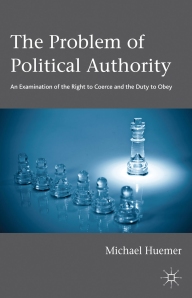 Political authority (hereafter, just ‘authority’) is the hypothesized moral property in virtue of which governments may coerce people in certain ways not permitted to anyone else, and in virtue of which citizens must obey governments in situations in which they would not be obligated to obey anyone else. Authority, then, has two aspects:
(i) Political legitimacy: the right, on the part of a government, to make certain sorts of laws and enforce them by coercion against the members of its society–in short, the right to rule.
(ii) Political obligation: the obligation on the part of citizens to obey their government, even in circumstances in which one would not be obligated to obey similar commands issued by a non-governmental agent.
If a government has ‘authority’, then both (i) and (ii) exist: the government has the right to rule, and the citizens have the obligation to obey.
In his book The Problem of Political Authority, Huemer argues that political authority is an illusion. No government, nor anyone else, actually possesses the special moral status that most people believe governments have.
While Rose also argues that nobody has political authority, he only devotes a portion of a single chapter (“Disproving the Myth”) to this task and the arguments he makes are quite weak. For example, in the section “Who Gave Them the Right?” Rose writes:
There are several ways to demonstrate that the mythology the public is taught about “government” is self-contradictory and irrational. One of the simplest ways is to ask the question: How does someone acquire the right to rule another? The old superstitions asserted that certain people were specifically ordained by a god, or a group of gods, to rule over others. Various legends tell of supernatural events (the Lady of the Lake, the Sword in the Stone, etc.) that determined who would have the right to rule over others. Thankfully, humanity has, for the most part, outgrown those silly superstitions. Unfortunately, they have replaced by new superstitions that are even less rational.
At least the old myths attributed to some mysterious “higher power” the task of appointing certain individuals as rulers over others – something a deity could at least theoretically do. The new justifications for “authority,” however, claim to accomplish the same amazing feat, but without supernatural assistance. In short, despite all of the complex rituals and convoluted rationalizations, all modern belief in “government” rests on the notion that mere mortals can, through certain political procedures, bestow upon some people various rights which none of the people possessed to begin with. The inherent lunacy of such a notion should be obvious. There is no ritual or document through which any group of people can delegate to someone else a right which no one in the group possesses. And that self-evident truth, all by itself, demolishes any possibility of legitimate “government.”
In reality, what Rose says above is true only given a certain individualistic conception of rights, such as Lockean property rights. Those who have not already been convinced that moral rights should work this way would be correct to point out that this is a weak argument.
Huemer’s arguments against political authority do not rest on controversial assumptions such as this, and I invite anyone who is not convinced by Rose’s rhetoric to consult Huemer’s The Problem of Political Authority. (Note: Prof. Bryan Caplan has said the same.)
Despite Rose’s arguments against political authority being less rigorous than Huemer’s, The Most Dangerous Superstition definitely has its strengths. A majority of the book is dedicated to describing the effects that the belief in authority has on peoples’ actions. Politicians, law enforcers, their targets, spectators, and advocates of government all behave significantly differently as a result of their belief in political authority.
For example, consider one effect of the belief in authority on police officers:
It is very telling that many modern “law enforcers” quickly become angry, even violent, when an average citizen simply speaks to the “officer” as an equal, instead of assuming the tone and demeanor of a subjugated underling. Again, this reaction is precisely the same – and has the same cause – as the reaction a slave master would have to an “uppity” slave speaking to him as an equal. There are plenty of examples, depicted in numerous police abuse videos on the internet, of supposed representatives of “authority” going into a rage and resorting to open violence, simply because someone they approached spoke to them as one adult would speak to another instead of speaking as a subject would speak to a master. The state mercenaries refer to this lack of groveling as someone having an “attitude.” In their eyes, someone treating them as mere mortals, as if they are on the same level as everyone else, amounts to showing disrespect for their alleged “authority.”
Similarly, anyone who does not consent to be detained, questioned, or searched by “officers of the law” is automatically perceived, by the mercenaries of the state, as some sort of troublemaker who has something to hide. Again, the real reason such lack of “cooperation” annoys authoritarian enforcers is because it amounts to people treating them as mere humans instead of treating them as superior beings, which is what they imagine themselves to be. To wit, if someone was confronted by a stranger (without a badge) who started interrogating the person in an obviously accusatory way and then asked to be allowed to search the person’s pockets, his car, and his home, not only would the person being accosted almost certainly refuse, out he also would probably be outraged at the request. “Of course you can’t rummage through my stuff! Who do you think you are?” But when strangers with badges make such requests, they are the ones offended when the targets of their intrusive, unjustified harassments, accusations and searches object, and refuse to “cooperate.” Even when the “officers” know full well that the Fourth and Fifth Amendments to the U.S. Constitution specifically dictate that a person has no “Legal” duty to answer questions or consent to searches, such “lack of cooperation” – i.e., the failure to unquestioningly bow to the enforcer’s every whim and request – is still seen by the “police” as a sign that the person must be some sort of criminal and enemy of the state. From the perspective of “law enforcers,” only a despicable lowlife would ever treat representatives of “authority” in the same manner as he treats everyone else. [pp. 64-5 (PDF pp. 60-1)]
Now consider the effect of the belief in authority on spectators observing conflicts between police and others:
The double standard in the minds of those who have been indoctrinated into authoritarianism, when it comes to the use of physical force, is enormous. When, for example, a “law enforcer” is caught on film brutally assaulting an unarmed, innocent person, the talk is usually about whether the officer should be reprimanded, or maybe even lose his job. If, on the other hand, some citizen assaults a “police officer,” nearly everyone will enthusiastically demand – often without even wondering or asking why the person did it – that the person be caged for many years. And if a person resorts to the use of deadly force against a supposed agent of “authority,” hardly anyone even bothers to ask why he did it. In their minds, no matter what the agent of “authority” did, it is never okay to kill a representative of the god called “government.” To the believers in “authority,” nothing is worse than a “cop-killer” regardless of why he did it. [pp. 103-4 (PDF p. 97)]
Given Larken Rose’s understanding of the two points above about how the belief in government authority influences peoples actions, I am sure that he would not be surprised by the recent case of Kelly Thomas, which I learned of last night. Police were caught on film brutally murdering Kelly Thomas in July 2011. The jury saw the video and, on Monday, amazingly declared the police not guilty. As Scott Wilson writes:
Kelly Thomas was a homeless, mentally ill man who was murdered by Fullerton, CA police officers Manuel Ramos and Jay Cicinelli. The police told him before they beat him to death that they were about to beat him. That is a fact that was part of the evidence, not a suppostion or hearsay — and was on video. The victim never resisted, unless you count trying to stop them from killing you by trying to get away “resisting.”
In this video, http://youtu.be/e6yaeD-E_MY?t=15m21s, at 15:21, killer cop Manuel Ramos says “see my fist, they’re getting ready to fuck you up,” and within 30 seconds they begin to beat him to death. As they were beating the life out of him, he was calling for his daddy saying “they are killing me.”
The cops outweighed the man by 60+ pounds, and there were first two of them and eventually six of them wailing on him, tasing him, literally physically suffocating him.
Manuel Ramos and Jay Cicinelli were merely charged with “striking Kelly Thomas with a baton and a stun gun in a beating that left him comatose.” Got it? Not charged with murder, or even manslaughter, even though they absolutely killed him — an uncontested fact. He died five days later from injuries they gave him, on video, with audio.
Today they were found not guilty and walked as free “men.” Clearly, if you are a cop, you can put on gloves to deliver a beating to someone who hasn’t raised a hand to you, tell them you are going to “fuck them up,” and then beat them into a bloody pulp, then tase them and beat them some more, and having it all caught on video AND audio, means that you are innocent.
The four other police officers who took part in what amounts to a gang slaying weren’t even charged.
Ramos and Cicinelli are now free to rejoin the force, make fists, threaten beatings on camera, deliver the beatings that lead to the death of victims — and they know they can do it with impunity. So do all the other officers in that police department and region — and around the country.
Ramos’ attorney, John Barnett, told reporters: “These peace officers were doing their jobs…they did what they were trained to do.”
~Scott Wilson
The most powerful and important, uninfluenced witness testimony: http://www.youtube.com/watch?v=kYJi3lgXLBU ~Antonio Buehler
Both the police’s attack and the jury’s not guilty decision demonstrate the powerful influence of the belief in government authority.

Kelly Thomas
It should be noted that observations about police only make up one part of the analysis of the effects of the belief in political authority. If people stopped believing in political authority, many other things would change as well.
For example, essentially everyone would come to view immigration restrictions as unjust and they would soon be abolished. The effects of this would be substantial. As economist Bryan Caplan points out, “Under free migration, labor would relocate to more productive regions, massively increasing total production. Standard cost-benefit analysis predicts that global GDP would roughly double.”
This is just one other example of many. For more, see the first section, “Some Policy Implications,” of Chapter 7, “What If There Is No Authority?” of The Problem of Political Authority.
Lastly, while my intention with this blog post was not to convince you to read either of the two books that I have mentioned, I do believe that they are both books that are definitely worth reading, regardless of whether or not you have already been convinced that there is no political authority. I highly recommend them both.
Advertisement: I tried Grammarly’s plagiarism checker free of charge because while copying is not theft, credit is still due. (See The Case Against IP: A Concise Guide for an overview of the many reasons why copyright, patent, and other laws protecting so-called “intellectual property” should be abolished.)

 Peace Requires Anarchy